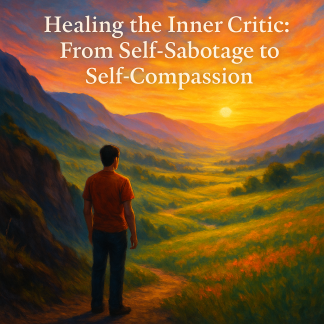
Healing the Inner Critic: From Self-Sabotage to Self-Compassion
A Relational Psychotherapy Perspective
Page 1: Understanding the Inner Critic
“Why do I speak to myself like this?”
If you’ve ever caught yourself in a spiral of self-blame, harsh judgments, or relentless perfectionism, you’ve likely met your inner critic. It’s the voice that tells us we’re not enough, that we should be doing better, or that we’ll never quite measure up.
In my work at Relational Psychotherapy, I often sit with people who carry this voice deep within them. It’s not a flaw — it’s a part of being human. For many, the inner critic formed as a misguided protector, an internalised message from early caregivers, schooling, or cultural pressures. It developed to help us stay safe, to push us toward success, or to avoid shame and rejection. But over time, this critic can become punishing, leaving us stuck in patterns of self-sabotage, anxiety, procrastination, or burnout.
The Roots of Self-Sabotage
Psychological theory — from psychodynamic models to Internal Family Systems (IFS) — shows us that the inner critic often emerges from early relational or cultural wounds. These are shaped not only by how we were parented, but by the broader messages we received from society about who we were allowed to be.
In my own experience growing up as a young gay man in the 1980s, the cultural landscape was awash with stereotypes, stigma, and shame. There weren’t many positive reflections of people like me, and it was hard to feel seen, safe, or celebrated for who I was. Like many others in similar positions, I internalised those messages. Over time, they formed a fierce inner critic that told me I wasn’t “good enough” — simply because I wasn’t straight.
For years, that critic drove me. It pushed me to over-perform, to please, to hide parts of myself for fear they would be rejected. It took time, therapy, and self-inquiry to realise that this voice — although loud — wasn’t the whole truth. It was a survival strategy. A part of me that had learned to be hyper-vigilant in a world that wasn’t always welcoming.
That healing — from internalised shame to self-acceptance — is what eventually led me to this work. And it’s why, at Relational Psychotherapy, I meet the inner critic in others not with judgment, but with deep understanding and care.
Because when we trace our self-sabotaging behaviours back to their roots, we often find pain. But we also find insight — and the possibility for growth, compassion, and integration.
Page 2: From Judgement to Curiosity
The good news? That inner critic isn’t all of who you are.
At Relational Psychotherapy, I often normalise the experience of having an inner critic and invite clients to explore it not as a villain, but as a part — a younger or scared version of the self that needs care, not condemnation.
Through the lens of self-compassion, we learn to decentre from the critic. Rather than fusing with its voice (“I am a failure”), we start to observe it (“That’s the critical part of me speaking — what does it need?”). This shift opens the door to curiosity, tenderness, and even transformation.
Taming the Critic with Compassion
Kristin Neff’s research on self-compassion has been instrumental here. She identifies three core elements:
-
Mindfulness — recognising the presence of suffering or criticism without over-identifying with it.
-
Common humanity — knowing we’re not alone in our struggles.
-
Self-kindness — actively offering warmth and support to ourselves in the face of difficulty.
When we apply these principles to our inner critic, we don’t just try to silence it. We meet it. We learn to say, “I see you. You’re trying to help me — but I’m safe now. I don’t need you to be so harsh.”
This is emotional maturity in action: the ability to respond to ourselves with compassion, even when we feel at our lowest.
Page 3: A Practice to Begin Softening the Inner Critic
Let’s finish with a practical task — a reflective and embodied way to begin this inner work.
🧠 The Compassionate Letter Exercise
-
Bring to mind a recent moment where your inner critic was loud. What did it say? How did it make you feel?
-
Now imagine a wiser, kinder, more compassionate part of you is writing to the critical part. This could be your therapist-self, your future-self, or even a nurturing figure from your life.
-
Write a letter from this part to your inner critic. Acknowledge its intention, but explain how it’s impacting you. Invite it to soften. Offer reassurance. You might write something like:
“Dear Inner Critic, I know you’re trying to protect me from failure. I see your fear. But your voice is hurting me. I don’t need to be perfect to be worthy. I am learning, and I am enough — even when I make mistakes.”
-
Read the letter aloud. Notice how it feels in your body. Do you feel resistance, relief, discomfort? All are welcome. This is a practice — not a performance.
At Relational Psychotherapy, I regularly support people through the process of befriending their inner critic. It’s not about silencing it or getting rid of it — it’s about offering it what it’s often been missing all along: understanding, compassion, and love.
Because when we speak to ourselves with kindness, we create the conditions for true self-development to flourish.
Love & Light Jon